
Kibbeh
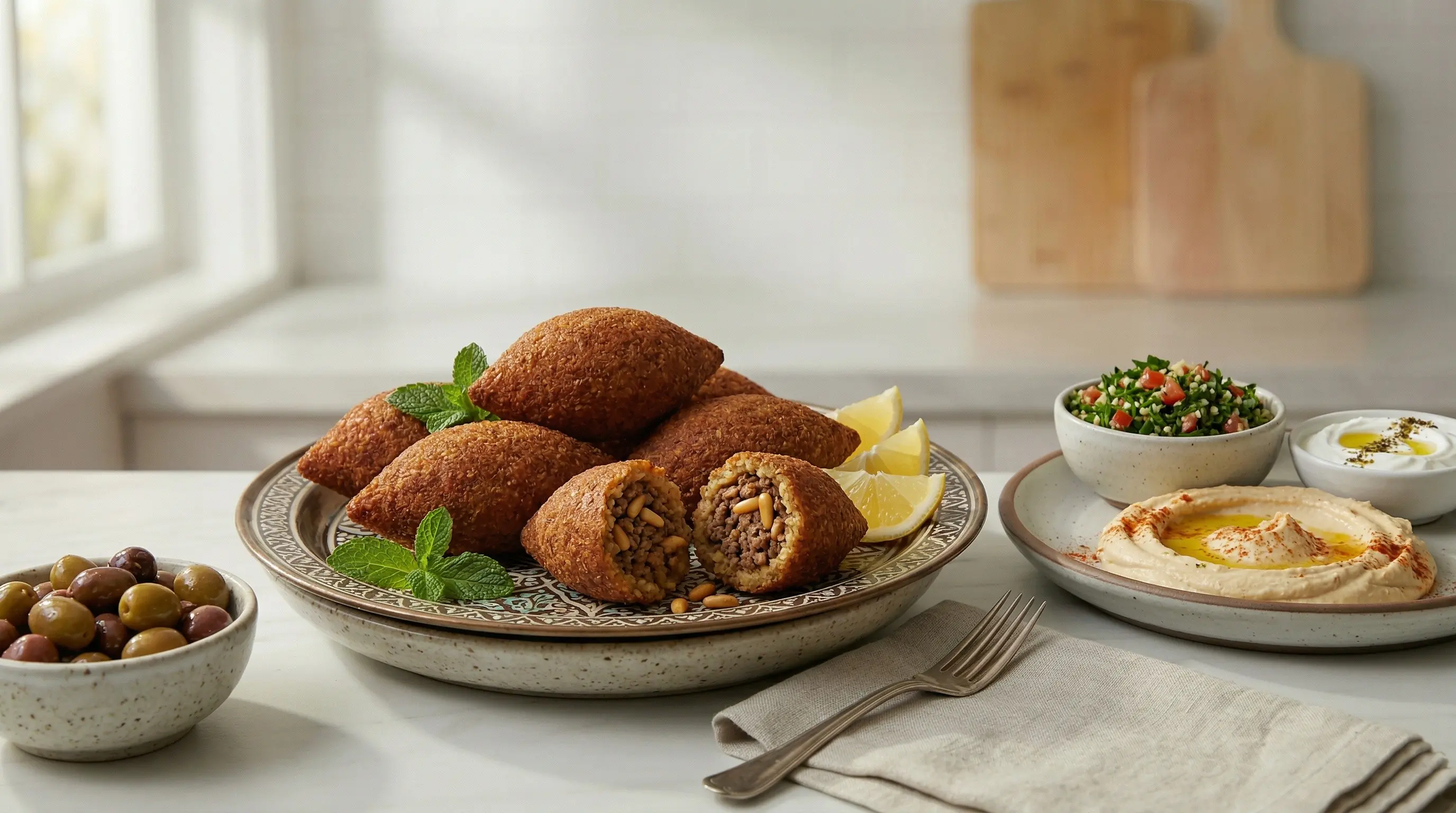
Learn how to make authentic kibbeh, the beloved Lebanese croquettes of spiced lamb and bulgur wheat with a savory meat and pine nut filling. This Middle Eastern classic is crispy, aromatic, and irresistible!
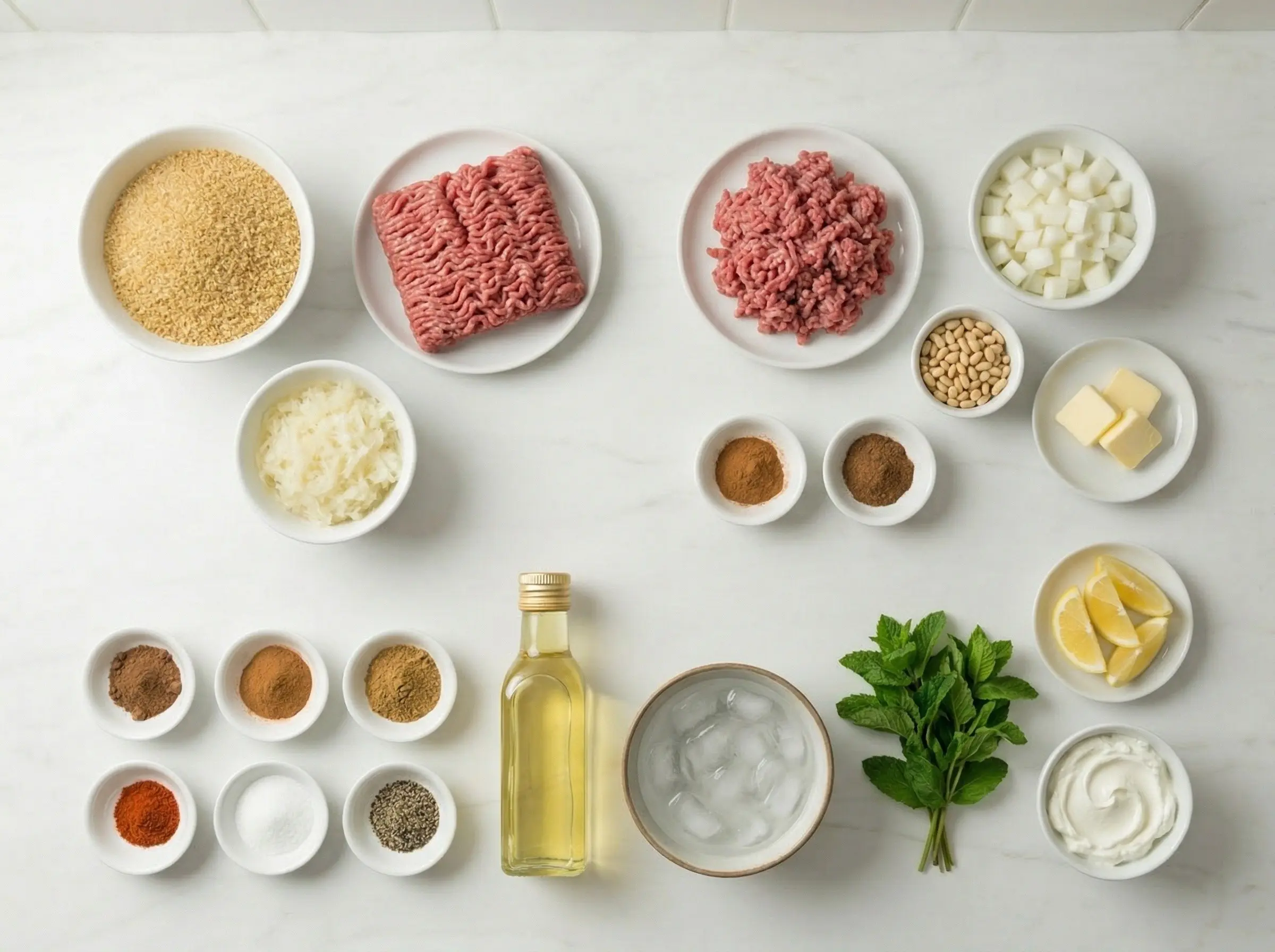
Ingredients
The Story
Kibbeh is considered the national dish of Lebanon and one of the crowning achievements of Levantine cuisine, a labor of love that transforms humble ingredients - bulgur wheat, lamb, and aromatic spices - into something extraordinary. The dish has ancient origins in the mountainous regions of the Levant, where it was traditionally prepared by pounding lamb and bulgur together in a large stone mortar called a jorn using a wooden pestle, a process that required significant skill and stamina. The rhythmic pounding would continue until the mixture achieved a smooth, paste-like consistency, a task that could take hours and was often a communal activity among women preparing for festivals and celebrations. Kibbeh exists in dozens of variations across Lebanon, Syria, Iraq, and the broader Middle Eastern diaspora, each region and family claiming their version as the authentic one. Kibbeh nayeh is raw kibbeh, served like a tartare with olive oil and fresh mint - considered by many to be the purest expression of the dish. Kibbeh bil sanieh is baked in a pan like a layered casserole. Kibbeh labanieh is simmered in yogurt sauce. But perhaps the most iconic version is kibbeh maqliyeh - the fried torpedo-shaped croquettes with a crispy outer shell encasing a filling of spiced ground meat, onions, and toasted pine nuts. These fried kibbeh are a centerpiece of Lebanese mezze spreads and a must-have at celebrations from weddings to Sunday family gatherings. What makes kibbeh so extraordinary is the textural and flavor complexity achieved through careful preparation. The outer shell, made from a mixture of fine bulgur, ultra-lean ground lamb, grated onion, and warm spices, must be smooth and pliable enough to shape yet firm enough to hold its form during frying. Achieving the right consistency requires careful balancing of moisture and meticulous kneading. The filling provides a savory counterpoint - coarsely ground lamb cooked with onions, allspice, and cinnamon, studded with buttery toasted pine nuts. When you bite through the shatteringly crisp fried exterior into the soft, spiced interior with its bursts of pine nut richness, you understand why kibbeh has been called the "queen of Lebanese cuisine." It is a dish that demands patience and skill but rewards the cook with one of the Mediterranean's most perfect foods.
Instructions
Step 1
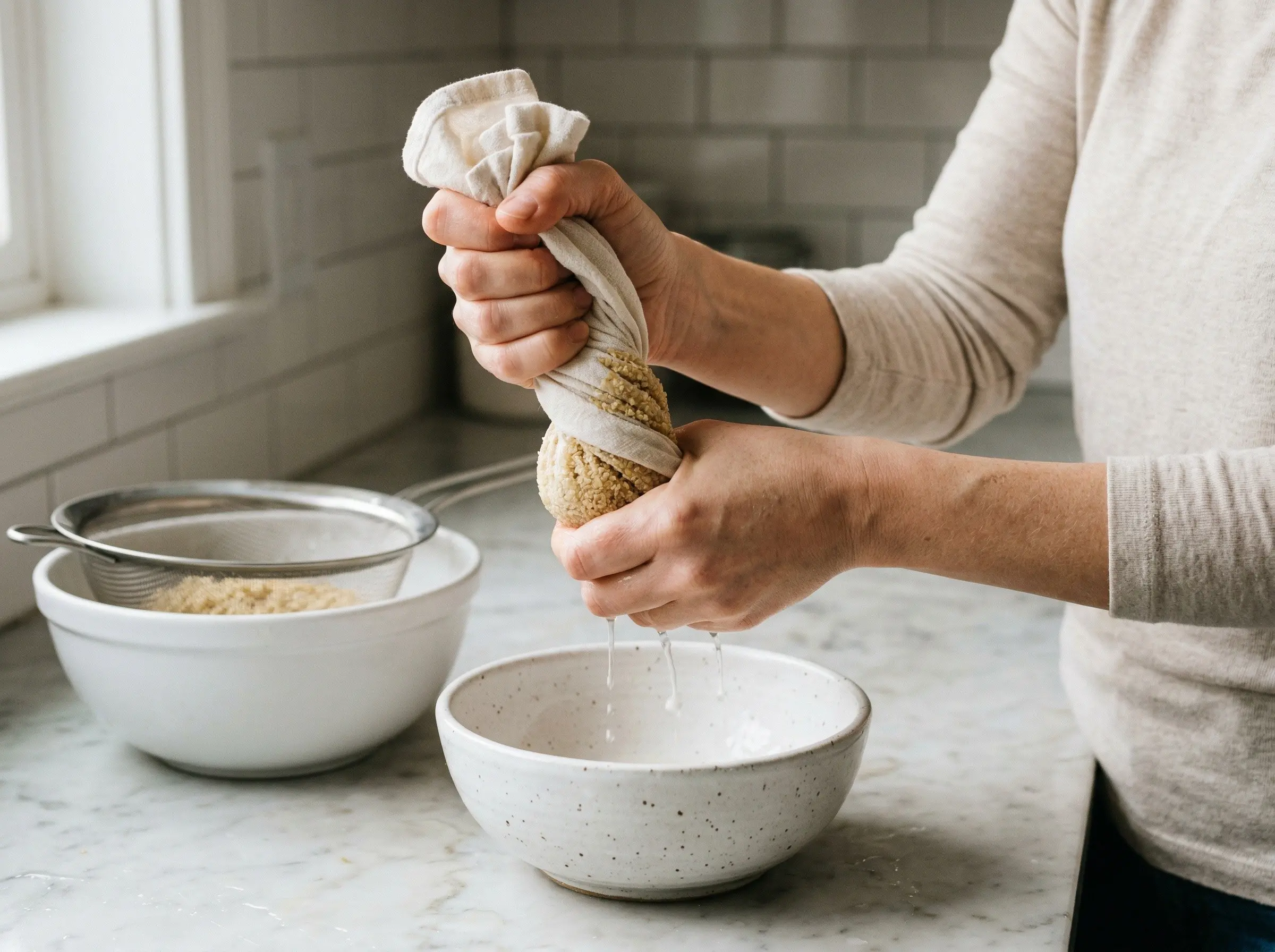
Prepare the bulgur. Place the fine bulgur in a bowl and cover with cold water by about 1 inch. Let soak for 15-20 minutes until softened but not mushy. Drain thoroughly in a fine-mesh strainer, pressing firmly to extract as much water as possible. Spread on a clean kitchen towel and squeeze dry - excess moisture will make the kibbeh shell difficult to work with and cause splattering during frying. The bulgur should be soft but not waterlogged. Use fine bulgur (#1), not medium or coarse, for the smoothest shell.
Step 2
Make the filling first so it can cool. Toast the pine nuts in a dry skillet over medium heat for 2-3 minutes, stirring constantly, until golden and fragrant. Transfer immediately to a plate to prevent burning. In the same skillet, melt the butter over medium heat. Add the diced onion and cook for 5-6 minutes until softened and lightly golden. Add the 8 oz ground lamb for the filling, breaking it up with a spoon. Cook for 5-7 minutes until browned and cooked through. Season with the filling spices (1/4 tsp each cinnamon and allspice), salt, and pepper. Stir in the toasted pine nuts. Transfer to a bowl and refrigerate until cool - warm filling makes shaping difficult.
Step 3
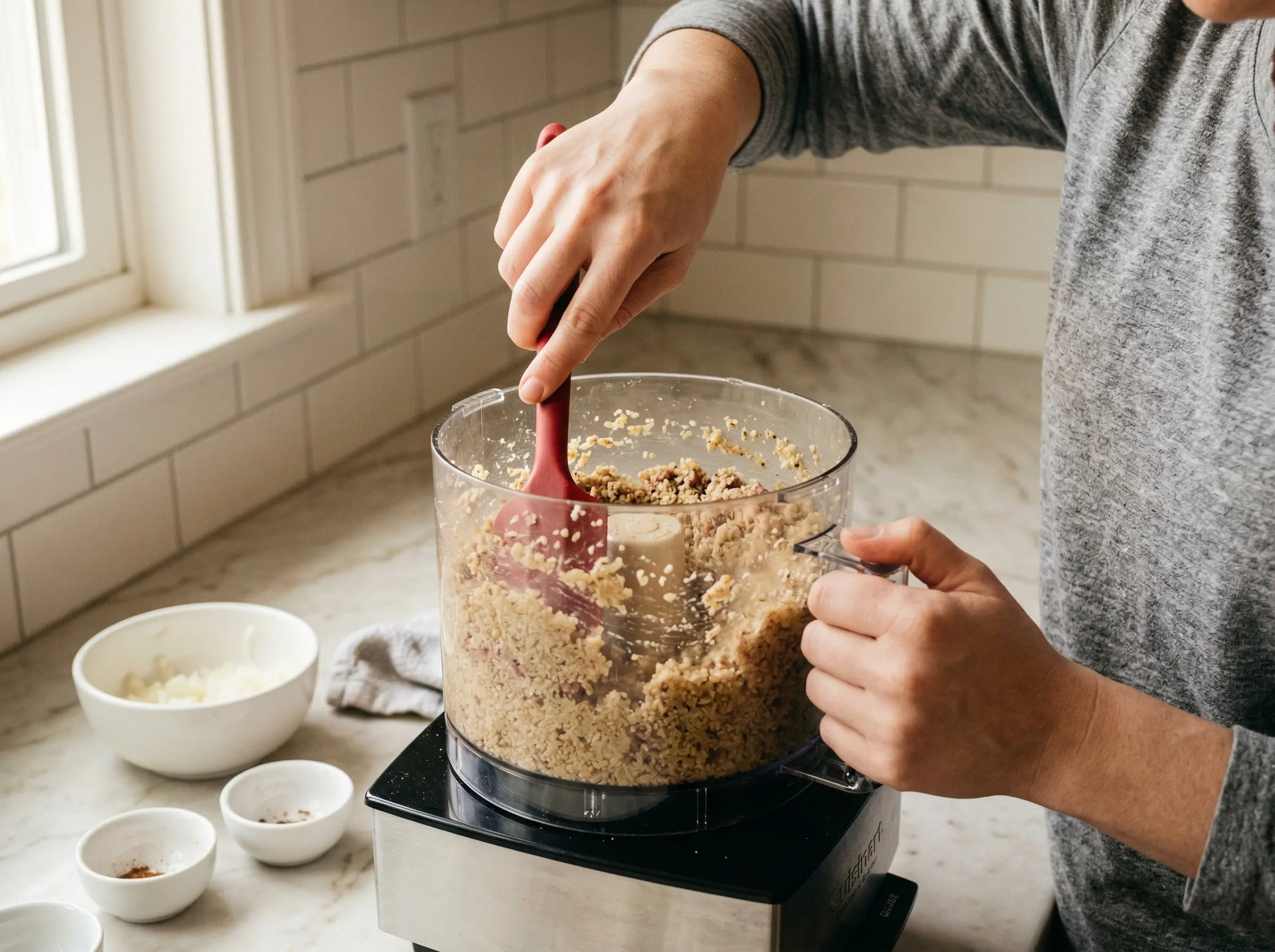
Make the kibbeh shell. In a food processor, combine the squeezed-dry bulgur, 1 lb very lean ground lamb, grated onion, allspice, cinnamon, cumin, cayenne, salt, and pepper. Process for 2-3 minutes, scraping down the sides occasionally, until the mixture forms a smooth, paste-like consistency. It should hold together when pressed and not be crumbly. If too dry, add ice water 1 tablespoon at a time. If too wet, add a bit more bulgur. Traditionally this was pounded by hand for up to an hour - the food processor is a blessed modern shortcut. Refrigerate the mixture for 30 minutes to make shaping easier.
Step 4
Shape the kibbeh. Keep a bowl of ice water nearby to wet your hands, which prevents sticking. Take a portion of the shell mixture about the size of a golf ball (roughly 2 tablespoons). Roll it into an oval, then hold it in one palm and use your index finger to poke a hole in the center, rotating and pressing to create a hollow cavity with thin, even walls - about 1/4 inch thick. The shape should resemble a hollow torpedo or football. Place about 1 tablespoon of the cooled filling inside the cavity. Pinch the opening closed, smoothing the seam and shaping into a pointed oval. If cracks appear, wet your fingers and smooth them over. Place shaped kibbeh on a parchment-lined tray. Repeat with remaining mixture - you should get about 16-20 pieces.
Step 5
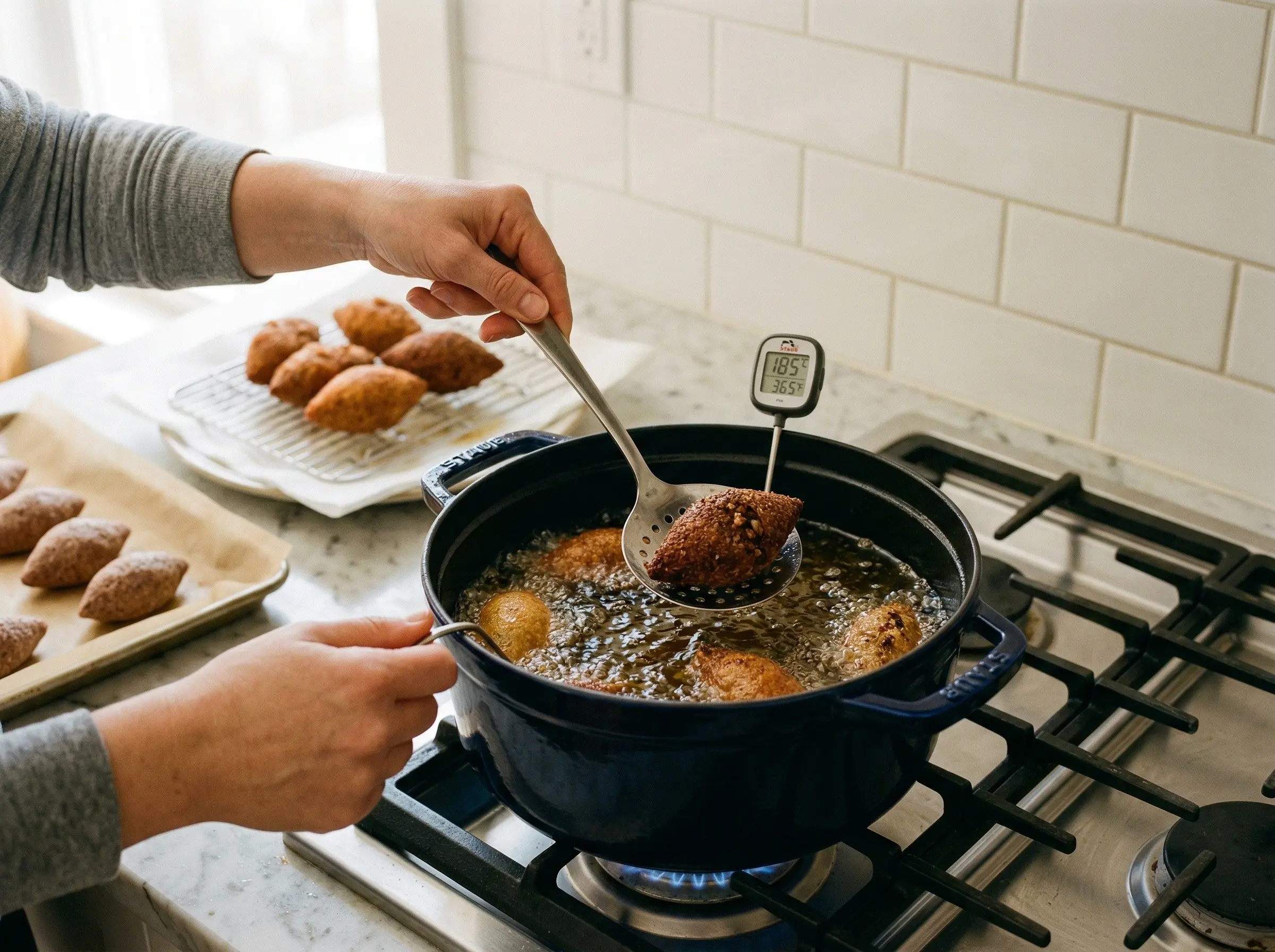
Fry the kibbeh. Pour vegetable oil into a deep pot or Dutch oven to a depth of at least 3 inches. Heat to 350-375 degrees F - use a thermometer for accuracy. Working in batches of 4-5 to avoid crowding, carefully lower the kibbeh into the hot oil. Fry for 4-5 minutes, turning occasionally with a slotted spoon, until deep golden brown and crispy on all sides. The shell should be shatteringly crisp. Transfer to a wire rack or paper towel-lined plate to drain. Allow the oil to return to temperature between batches. Keep fried kibbeh warm in a 200 degree F oven while frying the rest.
Step 6
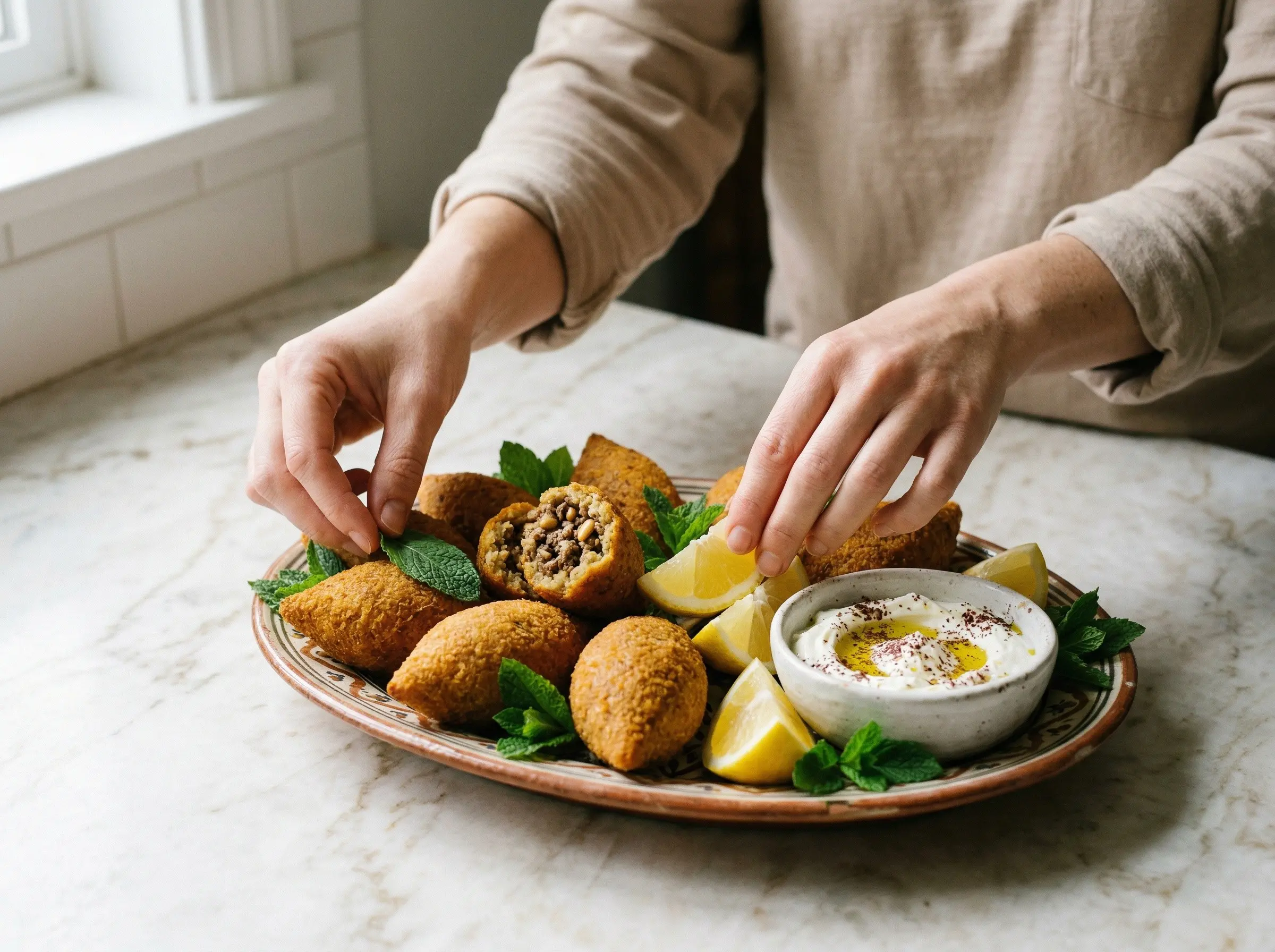
Serve immediately. Arrange the fried kibbeh on a serving platter garnished with fresh mint leaves and lemon wedges. Serve hot with labne or plain yogurt for dipping, alongside other mezze dishes like hummus, tabbouleh, and baba ganoush. Squeeze fresh lemon juice over the kibbeh just before eating - the acidity brightens the rich lamb flavors beautifully. In Lebanon, kibbeh is often served as part of an elaborate mezze spread, but it can also be a main course served with rice and salad. Leftover kibbeh can be refrigerated for 2-3 days and reheated in a 375 degree F oven for 10-12 minutes to re-crisp the shell, though they are best eaten fresh. For kibbeh nayeh (raw kibbeh), the shell mixture is spread on a plate and served raw with olive oil, mint, and fresh vegetables - only attempt this with impeccably fresh, high-quality lamb from a trusted butcher.
You Might Also Like
Master Your Kitchen with PantryAI
Love this recipe? Save it, shop for it, and cook it with ease. Download the PantryAI app to organize your pantry, track expirations, and discover recipes based on what you already have.

On a computer?Scan with your iPhone camera to download PantryAI.








Swipe to see more screenshots